

The Fire protection in industrial buildings Fire protection is a fundamental aspect of any industrial project, both from a regulatory standpoint and in terms of the safety of personnel and the continuity of operations. It's not simply about complying with a legal requirement, but about designing effective solutions that allow for the prevention, detection, and control of a fire should one occur. At ENGIND, we understand fire protection as a strategic part of the engineering project, integrated from the earliest design phases.
In Spain, the Fire protection in industrial buildings It is primarily regulated by the RSCIEI (Fire Safety Regulations for Industrial Establishments). This regulation establishes the minimum technical criteria that industrial buildings must meet according to their activity, surface area and level of risk, and directly conditions the construction design, the installations and the processing of the activity license.
What is the RSCIEI and why is it key to fire protection?
The RSCIEI is the regulation that defines the fire safety conditions applicable to industrial establishments, including production facilities, warehouses, logistics centers, and auxiliary buildings. Its main objective is to limit the risk of fire starting and spreading, facilitate the evacuation of people, and allow for effective intervention by emergency services.
For us, a correct Fire protection in industrial buildings This involves interpreting the RSCIEI rigorously and adapting it to each specific case. Applying the regulations from the design phase allows for the integration of efficient technical solutions and avoids subsequent modifications that often generate cost overruns and delays in construction. The official text of the RSCIEI can be consulted at the Official State Gazette.
Classification of the intrinsic risk of the industrial building
One of the most important aspects in a project of Fire protection in industrial buildings It is the correct determination of the intrinsic risk. The RSCIEI classifies industrial buildings into different risk levels based on the fire load, the type of activity carried out, and the materials stored or handled.
This classification directly influences the project design, as it determines the maximum permissible area of fire compartments, evacuation distances, the fire resistance of the structure, and the type of fire protection systems required. An incorrect risk assessment can lead to an inadequate or non-compliant project, with significant consequences during the legalization or inspection phase.
Fire sectorization and compartmentalization
Sectorization is one of the basic pillars of Fire protection in industrial buildings. Its function is to limit the spread of the fire within the building, facilitating both the evacuation of people and the action of the fire services.
The RSCIEI (Spanish Fire Safety Regulations for Industrial Establishments) establishes maximum compartment sizes according to the risk level, which requires the building to be divided using fire-resistant structural elements. This includes firewalls, floors, fire-resistant doors, and proper sealing of service penetrations. At ENGIND, we design compartmentalization in coordination with the structure and building services, seeking technical solutions that comply with regulations without compromising the functionality or operations of the building.
Active fire protection systems
Active protection systems are an essential part of any project Fire protection in industrial buildings. The RSCIEI defines which systems must be installed based on the surface area, risk and use of the building, guaranteeing an effective response to an incipient or developed fire.
Among the most common systems are detection and alarm systems, fire hydrants, portable fire extinguishers, automatic sprinkler systems, and smoke and heat control systems. The correct selection, sizing, and placement of this equipment is key to ensuring its effectiveness and proper compliance with regulations.
Evacuation and accessibility for emergency services
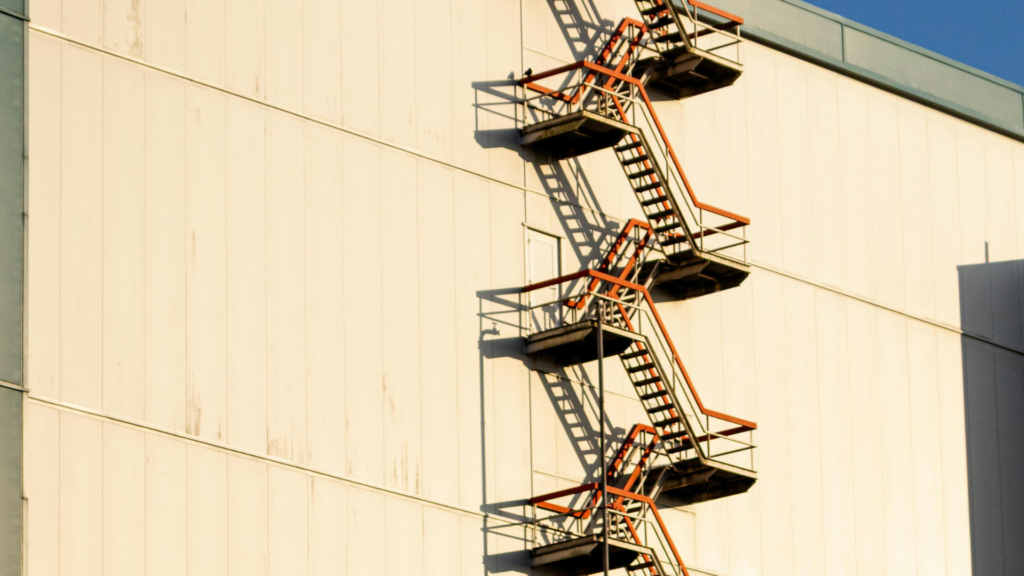
The Fire protection in industrial buildings It must also guarantee the safe and rapid evacuation of people. The RSCIEI establishes maximum travel distances, minimum widths of corridors and exits, as well as the obligation for emergency signage and lighting.
Furthermore, it is essential to ensure adequate accessibility for fire services, both inside and outside the building. This includes access roads, maneuvering areas, and conditions that allow for a rapid and effective response in the event of a fire, minimizing personal injury and property damage.
Integration of the PCI project into industrial engineering
At ENGIND we address the Fire protection in industrial buildings as an integral part of the industrial engineering project. This integration allows us to coordinate the PCI project with the structure, facilities, and operating license, avoiding incompatibilities and facilitating a smooth project execution. You can learn more about our approach to industrial projects at: https://engind.es/sectores-industriales/
The importance of a well-defined PCI project
The Fire protection in industrial buildings It is a key element for ensuring the safety, regulatory compliance, and viability of any industrial project. The RSCIEI provides the regulatory framework, but its correct application requires technical expertise, regulatory knowledge, and a comprehensive view of the project.
At ENGIND, we develop fire protection projects tailored to each industrial building, integrated from the design phase and aligned with the requirements of the RSCIEI (Spanish Fire Safety Code for Industrial Establishments). Choosing specialized engineering is the best guarantee for reducing risks, optimizing costs, and ensuring that the Fire protection in industrial buildings fulfill its primary function: to protect people, facilities and business activity.